
 English resume
Use of social media data in river restoration (COSAR)
Social media provides a platform for water managers to engage the public in conservation and restoration initiatives and to inform them about restoration planning and subsequent ecological impacts.
|
Thema |
Waterkwaliteit, COSAR: Improving the ecological status of rivers |
|
Tags |
|
|
Downloads |
1. INTRODUCTION
2. RELATED TOPICS AND DELTAFACTS
3. STRATEGIC CONTEXT
4. GRAPHICAL ABSTRACT
5. CONTENT
6. COSTS AND BENEFITS
7. SPECIFIC CONDITIONS
8. PRIVACY AND DATA
9. EXAMPLES OF (PRACTICAL) APPLICATIONS
10. KNOWLEDGE GAPS
1. Introduction
Ecosystem services (ES) are the benefits that people receive from natural ecosystems. These services include provisioning (e.g., food and water), regulating (e.g., climate and flood control), and supporting (e.g., nutrient cycling and soil formation) services. They also include cultural benefits, such as recreational, aesthetic, and spiritual values. These are non-material benefits that contribute to human well-being and cultural identity. These benefits are referred to as cultural ecosystem services (CES). An increase in CES can lead to greater interest and participation in the protection and restoration of natural areas, which can facilitate future efforts. Therefore, integrating CES into environmental management, conservation, and restoration strategies is a widely recognized goal.
Yet, there are no standardized frameworks to achieve this that are comparable to the measurement of the ecological outcomes of river restoration, for example. Currently, stakeholders and/or the general public are typically interviewed to determine available and demanded CES, either on-site or via questionnaires and surveys. However, this is a resource-intensive task, so the number of participants in such studies is often low. Another difficulty is achieving a balanced spectrum of participants representative of all sectors of society.
Assessing the societal effects of river restoration using social media can be used to overcome these difficulties. Social media can be a valuable resource for boosting the number of study participants, supplementing the demographic groups reached, and reducing the resources necessary to obtain information. It provides a common data source for many different restoration projects and allows for a unified analytical framework.
Online popularity can be identified through geo-tagged posts, revealing which natural areas are addressed, discussed, and valued more frequently for CES on social media. This can be derived by examining photo contents, hashtags, text comments, emojis, and image content, as well as reactions to others' posts in the form of reposts and likes. Specifically, analysing photos shared on social media provides qualitative and quantitative data on visitor activity and the perception and appreciation of ecosystems and their habitats. Analysing the written text of social media posts can also measure public sentiment and emotional attachment to places.
Another advantage of using social media as a data source for CES assessment is the ability to track changes in visitor perception over time (e.g., throughout different seasons or over the course of years). These analyses can also be performed retrospectively because social media platforms keep posts available. In turn, social media provides a direct platform for restoration practitioners to engage the public in conservation initiatives and inform them about restoration planning and subsequent ecological impacts.
2. Related topics and Deltafacts
COSAR Deltafacts
- Factors contributing to successful river restoration
- Monitoring of biological outcomes of river restoration
- Legacy effects affect river restoration outcomes
- DAPSIR: a predictive model of river restoration outcomes
3. Strategic context
To date, there has been a lack of standardized and widely recognized parameters and methods for monitoring CES and visitor perception in the environmental field, including river restoration. Although the European Water Framework Directive (WFD) calls for active involvement of the public, it does not address CES as an intended outcome of river restoration. Therefore, CES are not introduced as an assessed entity.
In the young discipline of evaluating social media data to study visitor percentages and CES of ecosystems, many approaches have been developed, and case studies demonstrate the various possibilities. Currently, there is much discussion in the scientific community about agreeing on a uniform method of assessing well-defined classes and types of CES from image content found on social media, beyond specific applications in restoration and conservation. However, this process is ongoing, and the framework presented in this fact sheet may require revisions in the near future.
A systematic approach to assessing CES by analyzing social media data for river restoration can identify areas of high cultural and recreational value and guide project planning. This approach also enables the monitoring and adaptive management of restoration efforts based on public feedback and engagement, ensuring their effectiveness and community support. This fact sheet provides an overview of established analysis pathways and suggests ways to implement the benefits of social media–based assessments of visitor perceptions and CES in restoration planning and monitoring.
4. Graphical abstract
Figure 1 shows the steps which could be followed to carry out a graphical analysis of social media photo postings to identify CES.
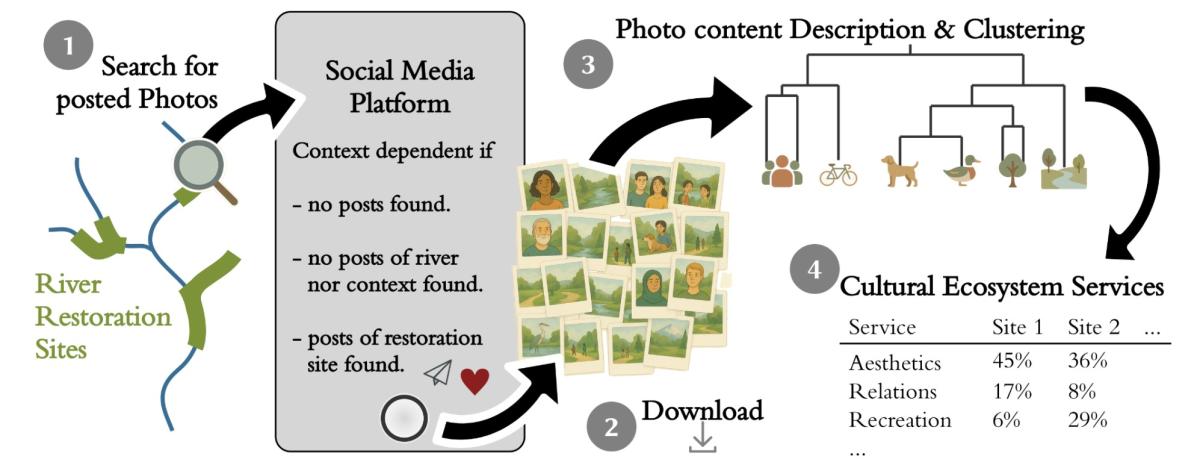
Figure 1. Procedure of identifying CES from social media data.
5. Content
The application of social media data in the context of river restoration depends on the most popular and relevant social networks at any given time. Currently, Instagram, a social media platform owned by Meta, is the most popular network for sharing pictures globally and lends itself to this application. Other platforms exist, albeit with fewer users and more specific interest groups, which could be significant locally. For example, Flickr is another popular dedicated photo sharing platform that emphasizes high quality photography and among others attracts users interested in nature observations that may cover relevant riverine locations.
How should social media postings be analysed?
This section of the Deltafact focuses on analysing photos related to river restoration projects. Captions, i.e., text written by users to accompany photos, may be available for additional analysis. This Deltafact will focus on the graphical analysis of photo postings and only briefly discuss the analysis of other information in the postings. Similarly, social networks that focus solely on text posts are not covered here.
Graphical analysis of photo postings could be carried out through the following steps (Figure 1):
1. To link postings to river restoration sites. Photos ideally can be captured directly via their recorded geolocation (e.g., Flickr) or by relying on user-tagged locations registered on the social network (e.g., Instagram).
2. Applications are available for each platform to download photos. For example, photos from Flickr can be downloaded via a command-line interface using the R programming language and the PhotoSearcher package. For Instagram, desktop applications such as 4KStogram are available. These solutions allow users to download all publicly available posts from both networks, along with metadata such as user ID, time, and date stamps..
3. After downloading, the photos are submitted to an automated image content recognition tool, that assigns labels describing the depicted content to each photo. Using a suite of methods derived from biological species community analysis, larger numbers of labelled photos can be examined to identify common content across all contributions associated with a river restoration project:
- A distance matrix representative of the similarity between photos based on their "local label community" can be computed given the presence or absence of labels across all photos.
- This distance matrix is then used to construct a dendrogram. The dendrogram represents the overall similarities of all photos, with more similar photos appearing closer together on its branches.
- Finally, hierarchical clustering can be used to group entire branches of the dendrogram into common categories of photo content. These categories can be interpreted by examining the most frequent labels in each cluster or by identifying the labels most responsible for the differences between branches. These calculations can easily be performed using the well-documented R package vegan, for instance.
4. The interpretation of resulting clusters of common picture content depends on specific study interests. Several metrics can be computed, such as richness and diversity of experiences, seasonal patterns, and the number of users posting about each restoration site.
It is also possible to translate these metrics into specific CES. For example, photos taken in atmospheric or ambient lighting conditions, such as pictures of a restored stream section at sunrise or sunset, can clearly be attributed to landscape aesthetics. Likewise, for people outdoors taking pictures of their cycling, hiking, or walking their dogs, the site clearly has recreational value. However, cultural ecosystem services, such as relational or spiritual values experienced by visitors, are far more difficult to interpret from pictures alone. Although frameworks for this purpose are being developed, currently, this must be assessed with caution on a case-by-case basis.
One can also look at the associated captions for each cluster of photo content categories. Corpus linguistic analysis can be used to compare users' expressed opinions, intentions, or emotions with the photo content, which leaves more room for interpretation. However, this analysis requires more expertise and case-by-case decisions, making it less suitable for widespread use.
Insights from using social media data: an example from the COSAR-project
In-depth results are available for 28 river restoration projects located in the Netherlands and Germany. A total of 17151 photos were downloaded and processed for these sites. After clustering, 6254 photos could be attributed to the restored streams or their immediate context (Figure 2).
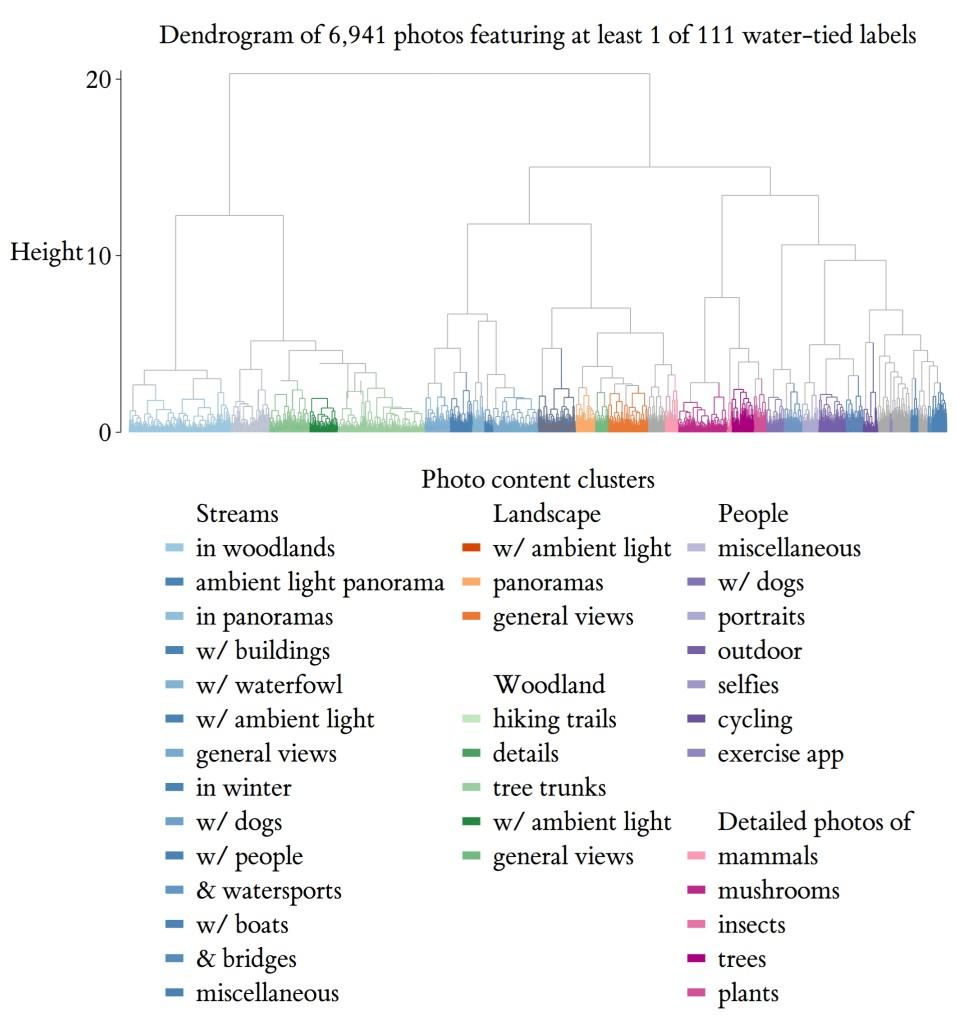
Figure 2. Dendrogram of photos from 28 restoration projects. The dendrogram breaks down the photos' content into clusters that can be generalized to depict streams, the riverine landscape as a whole, riparian woodlands, human-nature interactions, and biological details.
Clustering revealed that many photos do not depict the stream itself, but rather its context within a wooded area (n = 1643) or the landscape in general (n = 737). Additionally, many photos depicted human presence outdoors (n = 815) or detailed flora and fauna (n = 767) of the sites, but not the water surface itself.
Thus, a vast majority of the 2292 photos actually showed the water surface of the restored sites. These stream photos could be further differentiated into 14 distinct content clusters, such as water sports, woodland streams, stream panoramas, and people around streams.
However, a more detailed investigation showed that the proportion of these clusters varied considerably between sites. This implies that not all sites offer the same experience, or at least, are perceived the same. For example, the proportion of photos depicting people at restored sites ranged from 0 to 42 percent (mean = 18 percent). Furthermore, photos from one site stemmed from only three different content clusters, and photos of dogs in water made up 71% of the content alone (the mean percentage of photos of dogs in water across all other sites is 2%).
Thus, it is clear that social media can be used as a data source to analyse human-nature interactions around restored stream sites and trace specific human interests and variations in perception of the sites. The number and diversity of experiences and perceptions are site-specific and can be used to analyse trends across several sites. For example, it is apparent that the length of restored sites influences the diversity of experiences. However, it is also true that very small sites can be quite diverse and offer many different experiences (Figure 3).
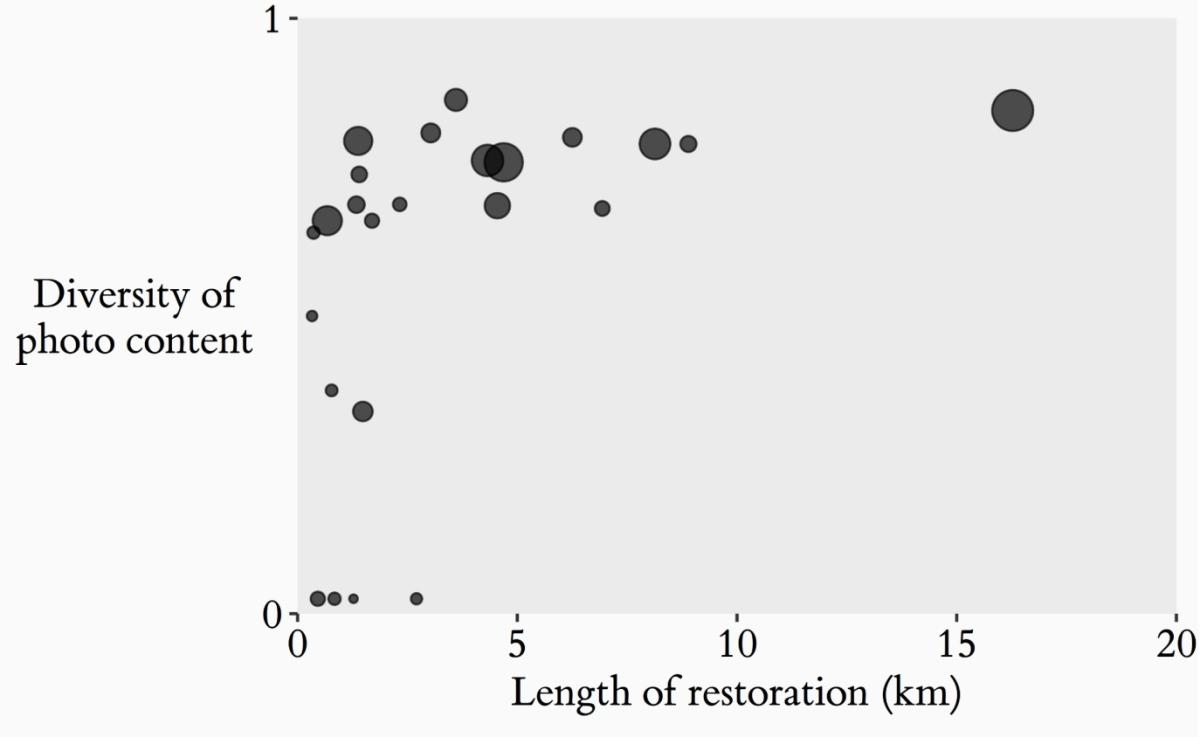
Figure 3. The length of restored stream sites and the diversity of photo content found there (calculated with the Shannon-Wiener diversity index) reveal that larger sites have more diverse user perceptions. In other words, there are no large sites with low photo content diversity. Conversely, some smaller sites have the same diversity as larger sites. The size of the points indicates the number of photos found at the respective restoration site.
When investigating the reasons behind differences in photo content composition among different restoration sites, the specific restoration measures at each project had no effect, at least according to COSAR's limited dataset. However, other factors may drive these differences. For example, we found that seasonal patterns in the same photo content cluster of stream panoramic photographs vary for certain sites (Figure 4). The number of stream panoramas at the urban stream Dommel in Eindhoven is lowest in summer, which follows the overall trend across all content clusters at that location. The number of panoramas is highest at the tourist site of the Graacher Lach on the Mosel River during the summer, which is the peak season for tourism in the area. However, less than 10 kilometres away on the same river, the site at Mühlheim peaks with panoramas during the fall due to interest in the local vineyards during grape harvesting season.
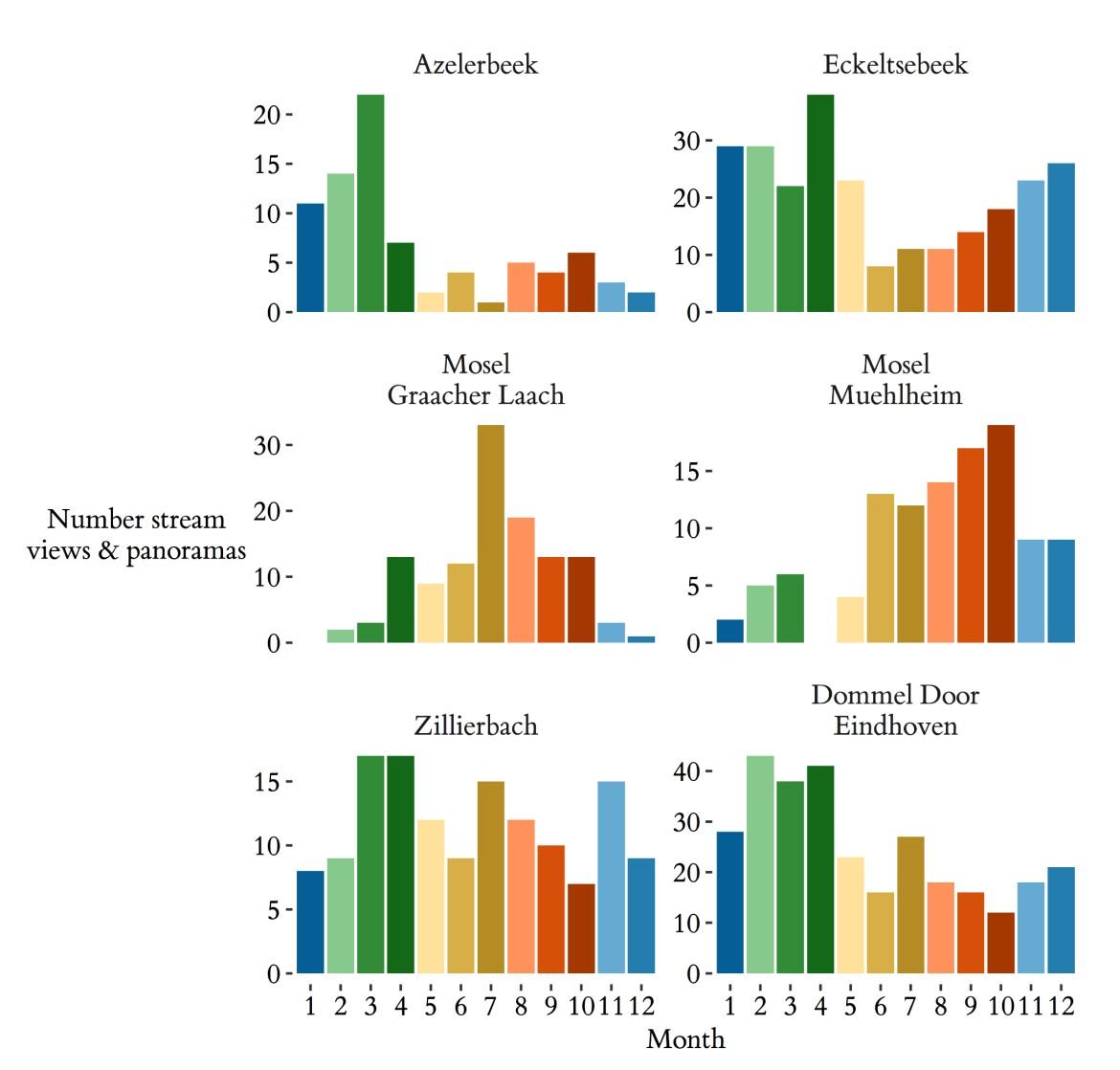
Figure 4. The number of panoramic photos taken monthly at five restoration sites, with colors indicating the season (blue for winter, green for spring, yellow for summer, and orange for fall).
Such detailed special interests cannot be explained by underlying trends in the dataset due to the uniqueness of the sites. Nevertheless, COSAR’s results demonstrate that these variances in user perception become traceable through social media, and its analysis has become an invaluable tool for detecting societal perception of restored stream sites.
6. Costs and benefits
Social media data seems to be a promising source of insight into human interactions in the context of stream and river restoration. Therefore, social media content can be stimulated for projects of interest. However, since most social media platforms (except Flickr) do not allow straightforward searches of posts based on their geolocation, workarounds must be used to associate future posts with river restoration projects. This is especially true for Instagram, the most widely used platform for sharing photos. For river managers, this means that, at an early stage in restoration planning, they should consider this aspect. Some platforms, such as Instagram, feature locations of interest on maps that users can tag in their posts to generate quasi-georeferenced data. These locations can be found on a proprietary map within the Instagram app and web interface. Since river restoration often occurs in areas without existing Instagram locations, practitioners may need to create them themselves.
7. Specific conditions
When analysing social media data to determine the value of CES in restoration, it is important to consider the discoverability of relevant content on social networks. This is partly due to the need for users to tag posts with specific location names on the most widely used network for sharing photographic content (Instagram). For older restoration projects, when social media did not yet exist or practitioners did not engage with creating an online location or initiate its use with their own posts, no social media content could be found for many restoration locations. This is partly because the context of restoration projects impacts whether visitors can access the site. Remote and poorly accessible sites limit the potential number of social media users who visit the project (Figure 5,6). Additionally, the intrinsic dynamics of social media come into play; existing content on a restoration project can trigger more content to congregate at the site.
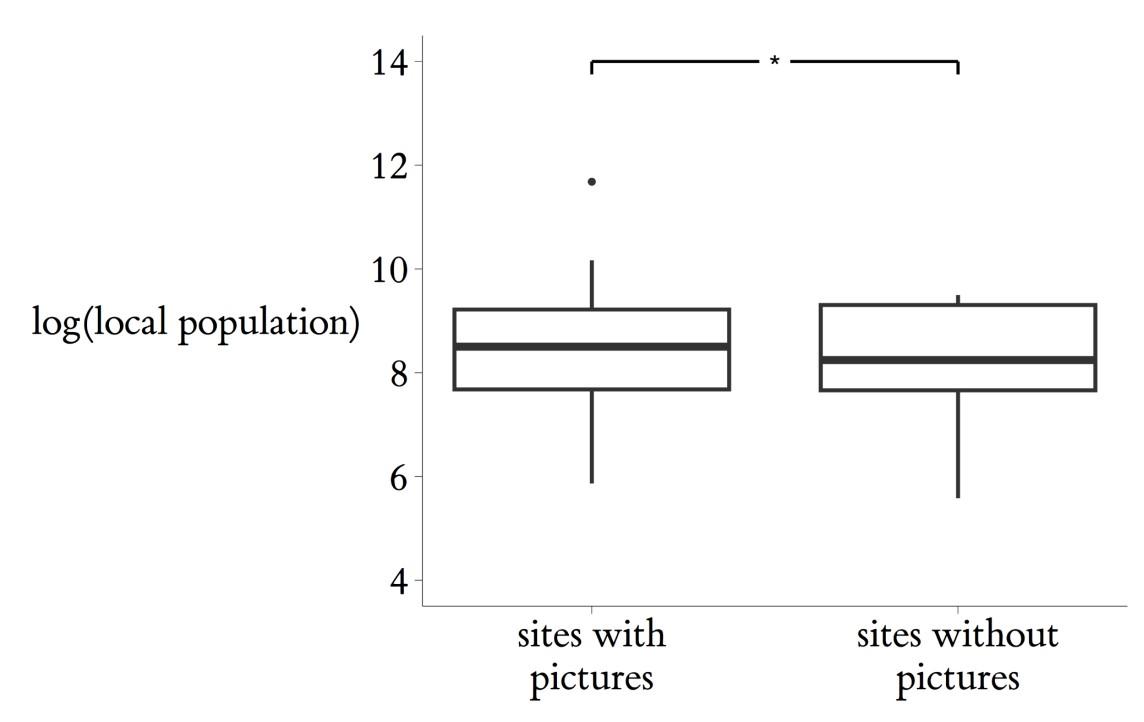
Figure 5. The number of people living within a 1.5 km buffer around restoration sites with photos on Instagram is significantly higher than sites without photos.
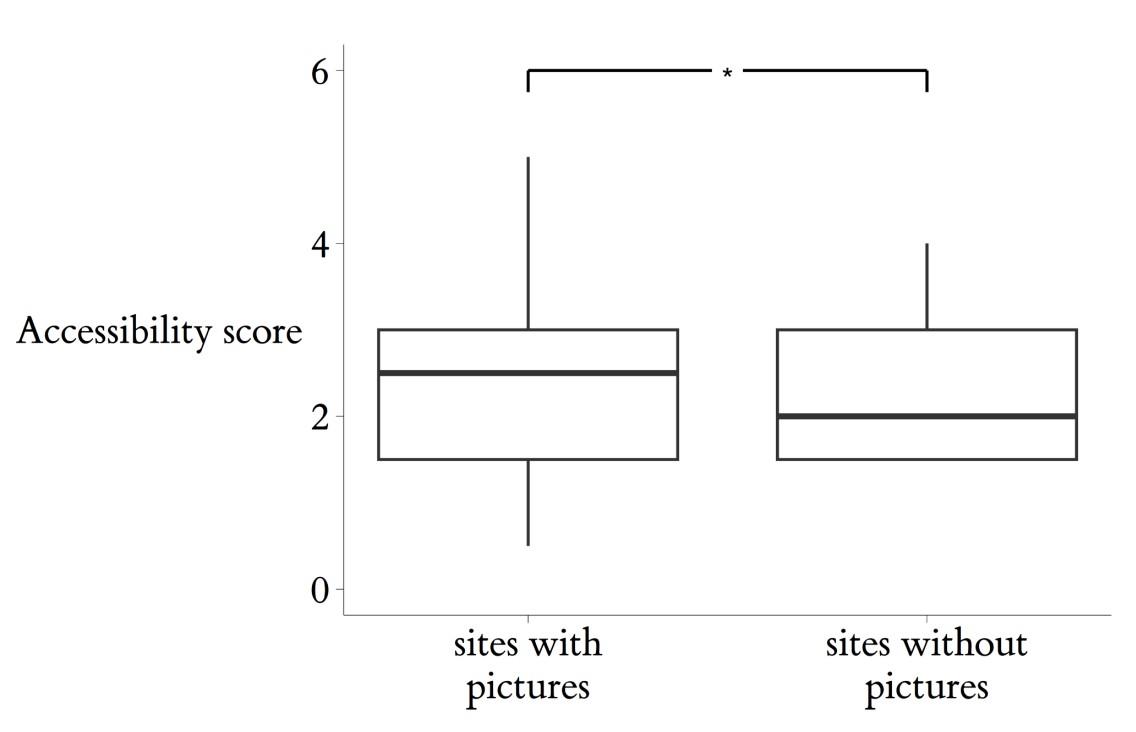
Figure 6. The accessibility of restoration sites for which photos can be found on Instagram is significantly higher than for sites where no pictures can be found.
8. Privacy and data
Since social media data is user-generated, it must be handled carefully and be subject to the social network's terms and conditions. While photos can be downloaded from social media sites such as Instagram, further processing should prevent the information from being traced back to users. To achieve this, an identification key should be assigned to any content posted on social media when it is downloaded, unless the software used to download it does so automatically. User-related metadata (such as links and usernames) should be separated from the data at this point, and removed during further analysis. A table of user metadata related to the identification key for the posted content may be retained but should not be shared with anyone not involved in the analysis. Once the analysis is complete, the original downloaded data should be deleted, and no records should be retained except for those that cannot be traced back to the original posts and users.
When presenting the results, it is forbidden to show the original content. In other words, it is not permitted to display or share the photos from Instagram, even if the username or link to the post is not shared simultaneously. For demonstration purposes, you should use your own photos or stock photos, not the original data.
9. Examples of (practical) applications
Although evaluations of the impact of river restoration projects on cultural ecosystem services (CES) are rare, some studies with practical applications exist.
For example, Kaiser et al. (2021) [https://doi.org/10.1016/j.ecoser.2021.101317] evaluated CES and their associated values at a restored river site on the Kishon River in Israel by analysing social media posts from visitors. After analysing 605 photographs from Flickr, VKontakte, and Instagram, the researchers identified seven photo clusters, six of which were directly related to the restoration site. These clusters reflected the instrumental and relational values of the environment. This method revealed previously unrecognized values and highlighted overlooked CES, such as existence and relational values. Thus, it is suggested as a cost-effective tool for enhancing future river restoration and freshwater management projects.
Similarly, Kaiser et al. (submitted) found that photos posted online can approximate human-nature interactions and CES along hydromorphological gradients. This study analyzed 2,723 Flickr photos along the partially restored Emscher River in Germany. The results showed that photos from higher-quality habitat sections focused more on nature and biodiversity, while photos from lower-quality areas highlighted urban landscapes. These results suggest that river restoration enhances the perception of nature and strengthens human-nature relationships, which are crucial for biodiversity conservation and management.
10. Knowledge gaps
Currently, there is no simple way to automatically translate the photographic content of social media posts into different categories of cultural ecosystem services (CES). This step still requires a visual assessment by the researcher on a case-by-case basis. Although attempts have been made to link specific photo motifs to a set of fixed CES rules, these have not yet found widespread practical application.
Any evaluation of CES based on social media data must consider possible biases in each social network's user groups. These groups may represent different demographics and may migrate from one network to another over time. Similar to traditional surveys, these groups may not be representative of a larger population. These dynamics and unknowns must be considered when analysing social media data, and caution should be exercised when interpreting the results. Nevertheless, social networks often have the potential to be more inclusive than survey respondents, and it would be a misconception to assume that only younger people use them.