
 English resume
Legacy effects affect river restoration outcomes (COSAR)
This Deltafact focuses on the influence of the historical context as a constraining factor for stream and river restoration. A better understanding of the past conditions at a site in the planning phase of restoration projects could lead to more realistic project aims and better restoration outcomes.
|
Thema |
Waterkwaliteit, COSAR: Improving the ecological status of rivers |
|
Tags |
|
|
Downloads |
1. INTRODUCTION
2. RELATED TOPICS AND DELTAFACTS
3. STRATEGIC CONTEXT
4. GRAPHICAL ABSTRACT
5. CONTENT
6. COSTS AND BENEFITS
7. SPECIFIC CONDITIONS
8. GOVERNANCE
9. IMPLICATIONS FOR PRACTISIONERS
10. KNOWLEDGE GAPS
1. Introduction
The ecosystems in Europe as present today are the result of a long history of interaction with human societies. Watercourses in particular have been impacted for centuries. Records of human interventions in river ecosystems date back to the Middle Ages. Practices such as fisheries, damming, flood protection works, logging of riparian forests, and water mill construction were common. Even more drastic modifications have taken place since the Industrial Revolution, including channelization and normalization of river channels, construction of embankments, water pollution, water abstraction, and fundamental land use changes.
Taking this history into account is crucial for comprehending the current functioning of aquatic ecosystems, particularly since past human actions persistently affect waters even when the original stressor is no longer present. These delayed effects are known as "legacy effects": any persistent signs in the contemporary ecosystem's structure or function resulting from past human activities (Antonelli et al., 2024 https://doi.org/10.1002/wat2.1729; Wohl, 2019 https://doi.org/10.1029/2018WR024433). As legacy effects affect the contemporary structure and functioning of aquatic ecosystems, they can potentially hinder or facilitate the restoration of these environments. Therefore, knowledge of these effects is essential for restoration planning (Case & Hallett, 2021 https://doi.org/10.1111/rec.13411)
2. Related topics and Deltafacts
River restoration; past environmental pressures; trajectory of temporal evolution
COSAR Deltafacts
- Factors contributing to successful river restoration
- Monitoring of biological outcomes of river restoration
- Use of social media data in river restoration
- DAPSIR: a predictive model of river restoration outcomes
3. Strategic context
Legacy effects are relevant for all regulations related to river restoration: Water Framework Directive (WFD), Nature Restoration Law (NRL), and the UN Decade for Restoration (2021-2030). The WFD encourages the hydromorphological restoration of waterways to improve their ecological status. However, 20 years later, the ecological effects of the implemented restoration measures appear to be limited. Technical reasons have been put forward, such as inappropriate restoration scale. The spatial context is often not considered, whilst pressures in the catchments where restoration measures are located can hinder recovery processes. Other reasons are poorly adapted measures in the absence of status diagnostics, and lack of monitoring. Similarly, the historical context must be considered before restoration begins, because past anthropogenic pressures may affect the current state of the watercourse and influence the outcome of restoration measures.
4. Graphical abstract
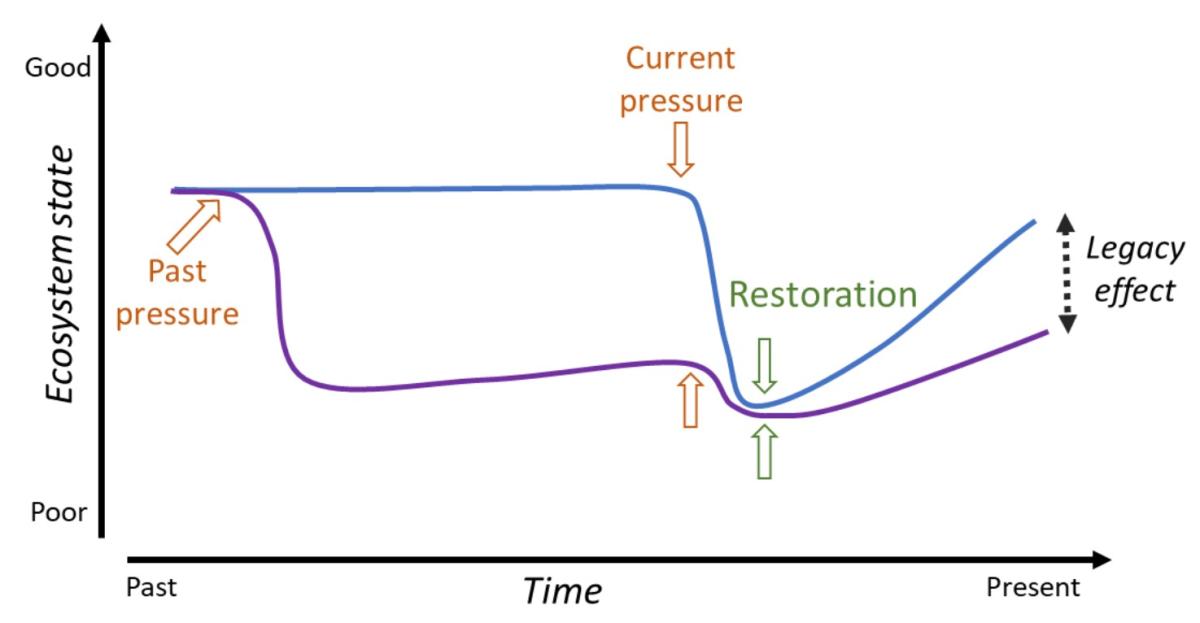
Plotting schematic restoration trajectories through time can help explain the influence of legacy effects on restoration (Figure 1). Two in the past similar streams in good condition have experienced different histories of degradation. Past pressure from human activities, such as mining, affected only one of the streams (purple trajectory), leading to an impaired state. Once the pressure ceased, the effects were still present, but the stream began a slow self-recovery process (if possible, given the nature of the pressure). Meanwhile, the other stream (blue trajectory) remained unchanged. Several decades later, both streams were adversely affected by another pressure, such as channelization. Then, to improve their ecological condition, a restoration measure is implemented. Both streams responded positively to the restoration measures, but the stream that had previously been affected by pressure was less likely to recover due to the burden of its past. The difference in the two post-restoration trajectories corresponds to the legacy effects.
5. Content
Identifying legacies in freshwater ecosystems
Here, we define legacies as the persistent effects resulting from past human activities that significantly altered water bodies and their associated watersheds. The difficulty with this concept is that, even if the effects are still occurring, the original activities that caused them may no longer be easily observed. Historical anthropogenic activities that likely cause legacies are (Antonelli et al., 2024 https://doi.org/10.1002/wat2.1729):
- Land use changes, such as converting natural habitats for agriculture or urban expansion;
- Exploitation of watercourses and their watersheds, e.g., riverbed mining, leaching from mine tailings, logging, or timber floating;
- Regulation of species: e.g., beaver hunting, fish introduction, or fish farming;
- Direct modifications of watercourses, such as mill ponds, dams, and road construction.
Overview of known effects
Land Use
Effects that have probably been studied the most are changes in land use over time. Using land use as a proxy for past human activity has the advantage of covering several types of disturbances at once. For instance, the development of agriculture in a watershed often leads to an alteration of the watercourse, including modifications to sedimentary processes (e.g., increased surface runoff and sediment transport), changes in channel structural heterogeneity (e.g., decreased coarse particulate organic material input and the absence of dead wood after logging of riparian forests), and alterations to water quality (e.g., nutrient inputs from agricultural lands). These modifications lead to a response from the aquatic biota in terms of, amongst others, species richness and composition. This response may be immediate or delayed due to various processes, such as the existence of an extinction debt, the modification of the regional pool of species, and community dynamics.
The legacy effects of past land use on aquatic biodiversity are well documented. For example:
- Changes in land use between 1945 and 2002 affected the composition and richness of macrophyte populations in lakes in Aquitaine (Jamoneau et al., 2020 https://doi.org/10.1111/jvs.12839).
- Past land use in 1950 constrains the contemporary diversity of fish and macroinvertebrate populations in small streams in the USA (Harding et al., 1998 https://doi.org/10.1073/pnas.95.25.14843).
Water Quality
The legacy effects on biogeochemical cycles, as well as on water and sediment quality, are well known. Mining, industrial (e.g., metallurgy and washeries) and agricultural activities have introduced chemical substances into the aquatic environment, either directly or indirectly. These inputs can result in stocking or build-up effects in groundwater and soil, which can lead to the delayed contamination of watercourses and act at a larger scale within the watershed. Significant levels of priority substances have built up as a result of historical use and this legacy pollution may persist in water bodies long after pollutant discharge and inputs have ended (EEA, 2018 https://www.eea.europa.eu/en/analysis/publications/state-of-water).
Water Quantity
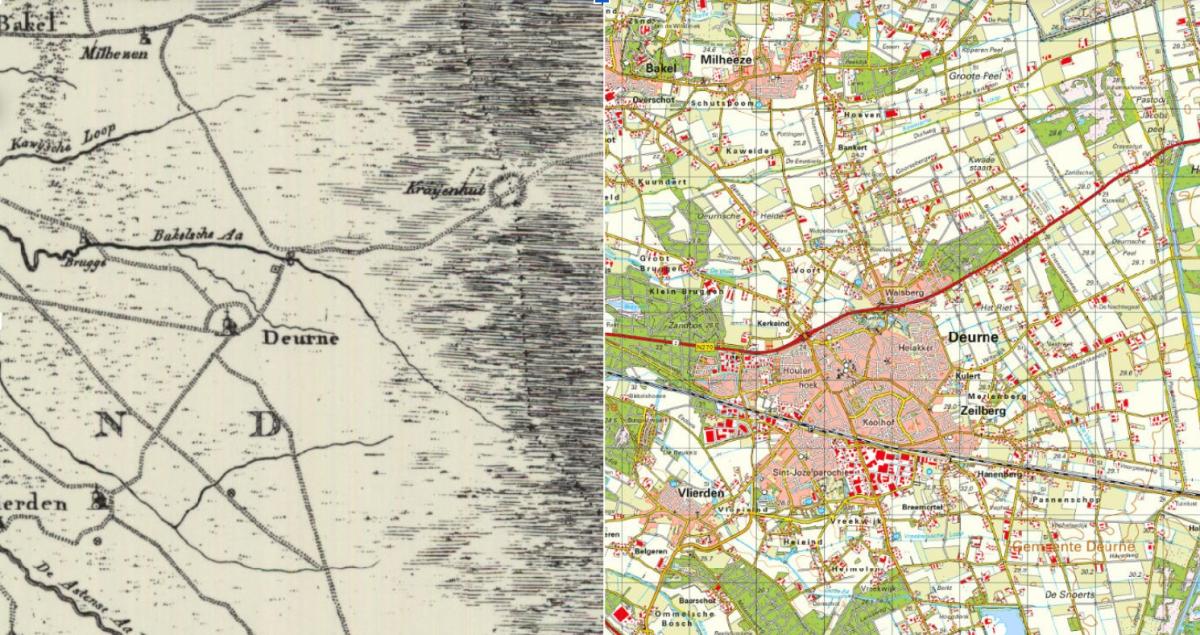
Successful restoration of ecological flows may depend on pre-existing ecological conditions that constrain the time, magnitude, and duration of the environmental response (Thompson et al., 2017 https://doi.org/10.1111/fwb.13029). In the Netherlands, the large-scale drainage and excavation of peat bogs covering the higher grounds of the provinces of Noord-Brabant and Limburg in the 19th century had a huge and irreversible effect on the hydrological functioning of these watersheds, as these bogs formed the source of many river systems. Nowadays, only very small fragments of the historic peat bog landscape remain; the rest of the land has been converted for agricultural use. The peat acted as a sponge with high water retention capacity and slow downstream water release. The network of drainage channels that replaced the peat bogs does not have this capacity, leading to lowered water tables, increased peak discharges, and periods of low flows (Figure 2).
6. Costs and benefits
If legacy effects are identified, they are helpful in setting realistic restoration goals and the prioritization of specific restoration measures. For example, in the case of polluting activities in the past, it is crucial to remove contaminated sediments before taking any other restoration actions.
7. Specific conditions
The assessment of legacies depends on the availability of historical information. One could investigate whether such activities existed at a local scale, in a particular site, or in a watershed. An important source of information are old topographical maps. Historical maps are available online for, amongst others, the Netherlands (www.topotijdreis.nl) and France (www.geoportail.gouv.fr/). On a larger spatial scale, HILDA (http://www.geo-informatie.nl/fuchs003/#), a Europe-wide resource on the evolution of land use over the 20th century, could be used.
Other important sources of information could be written documents with historical descriptions, historic aerial pictures, photographs, and postcards. Collaborating with environmental historians and leveraging local knowledge, such as from historical or naturalist associations, is beneficial in this process.
8. Governance
The trade-off between conserving the historical legacy and achieving river restoration goals could be challenging. For instance, modifications to rivers made for water-powered mills are now considered an obstacle to the hydrological and ecological restoration of bodies of water. However, these old infrastructures sometimes cannot be modified due to patrimonial conservation purposes.
9. Implications for practitioners
Currently, legacy effects have not been extensively studied in the context of river restoration. However, given their potential role alongside contemporary drivers in influencing biodiversity, it is important to include them in the river restoration process. In other words, in the diagnostic phase of a project not only the current pressures but also the former pressures should be taken into account. They must be considered to identify the best locations for restoration at the basin scale, assess a site's potential for restoration, design the most effective restoration measures, and evaluate the context's suitability for the restoration measures' success.
Furthermore, it is important to consider that our current actions on rivers will be legacies in the future. Thus, we should adopt a longer temporal perspective when managing water bodies.
10. Knowledge gaps
Legacy effects are often considered alongside other contemporary drivers. They are not necessarily predominant, but they always contribute to explaining the current state. Disentangling the respective effects of contemporary versus past human activities is challenging.
Many studies consider legacy effects in waterways based on knowledge of changes in land use. However, other factors may also play a role, such as sediment dynamics and the introduction of species. These factors have been studied little to date, probably because useful historical information is difficult to find.
Additionally, the impact of legacy effects on social dynamics surrounding watercourses and their restoration has not been examined. Are the history of management methods and governance susceptible to influencing the current choice of river restoration activities?
Past conditions can potentially influence restoration outcomes by modifying the trajectories of ecosystems. Further studies should focus on analysing the trajectories of restored rivers' evolution, to better understand the strength of legacy effects. These studies could also address the conditions for the persistence of past effects. For example, is it a matter of the magnitude, intensity, or duration of anthropogenic disturbances which determines its effect?