
 English resume
DAPSIR: a predictive model of river restoration outcomes (COSAR)
In this Deltafact a conceptual model, DAPSIR, is presented which describes the physical responses of streams and rivers to restoration measures and their impact on selected ecological metrics for fish and macroinvertebrate communities. The DAPSIR model compares the physical states before and after restoration, as well as the associated changes in community metrics.
|
Thema |
Waterkwaliteit, COSAR: Improving the ecological status of rivers |
|
Tags |
|
|
Downloads |
1. INTRODUCTION
2. RELATED TOPICS AND DELTAFACTS
3. STRATEGIC CONTEXT
4. GRAPHICAL ABSTRACT
5. CONTENT
6. COSTS AND BENEFITS
7. SPECIFIC CONDITIONS
8. GOVERNANCE
9. EXAMPLES OF PRACTICAL APPLICATIONS
10. KNOWLEDGE GAPS
1. Introduction
River restoration has increased significantly in Europe, primarily due to the Water Framework Directive (WFD). Many guidelines have been developed to inform new restoration practices, emphasizing the need to improve not only local habitats, but also the morphological and ecological state of rivers. However, the outcomes of these new practices vary greatly and depend on larger scale context factors that control physical and ecological processes. To improve the efficiency of restoration, it is essential to implement the most accurate set of measures for the environmental context. Therefore, we need to better understand the joint effects of context and pressures on river systems and develop methods to predict the outcomes of restoration measures.
The decision-making process that leads to the local implementation of restoration activities could influence the success or failure of these activities. General objectives and frameworks are usually established at a higher level (e.g. WFD objectives) and then adapted to territorial structures and objectives. Ultimately, implementation decisions are often made at the local level and are subject to local constraints. For instance, private land ownership around streams often limits the ability to select new restoration sites. These local constraints may lead to the opportunistic implementation of restoration activities in available sites rather than targeting the most relevant parts of the network. This can lower the expected benefits of the planned restoration. Therefore, considering stakeholders' activities, decisions, and constraints (e.g., random opportunities, strong societal demand, long-term and/or large-scale planning, and river and adjacent land owning management) as possible structuring factors might provide new insights into restoration outcomes.
Furthermore, strong societal expectations and positive perceptions of restoration may play a stronger lobbying role with decision-makers and stakeholders, possibly leading to more restoration activities. Therefore, societal perceptions and feedback must be better understood and considered when describing restoration implementation. In fact, the societal perception and benefits of restoration outcomes must be balanced more accurately with ecological outcomes. Trade-offs between ecological and societal outcomes are important because a restoration action that is ecologically irrelevant might still provide a significant amount of societal benefits.
To address these challenges, we present an improved environmental management framework that better introduces the decision-making process involved in restoring river ecosystems and enhances the understanding and prediction of possible restoration activity outcomes, considering ecological and societal aspects depending on the environmental context.
2. Related topics and Deltafacts
Keywords: river restoration, prediction of ecological outcomes, Bayesian modeling.
COSAR Deltafacts
- Factors contributing to successful river restoration
- Monitoring of biological outcomes of river restoration
- Legacy effects affect river restoration outcomes
- Use of social media data in river restoration
STOWA Deltafacts
3. Strategic context
Decades after the WFD, we have learned that the ecological success of stream and river restoration projects is often limited. One possible explanation is technical. Restoration projects may be too small or may only target limited aspects of a wider ecological problem. For instance, restoration efforts may focus on a local microhabitat in a widely modified river. More ambitious designs that target ecological functions or processes may be implemented in areas that are too degraded (poor local and/or regional environmental conditions), or the survey design may not be sufficient to observe positive outcomes. Lastly, project designs may not sufficiently anticipate unexpected effects, such as the takeover of invasive species, or dismiss the effects of climate change.
A second reason for perceiving restoration projects as unsuccessful is the lack of consideration for societal perception. Indeed, societal perception of restoration is still poorly considered when analyzing project outcomes. However, an increase in societal well-being could be considered a positive outcome of ecological restoration, even when the ecological outcomes are limited. Taking into account the potential benefits of ecological restoration on societal well-being is also a way to integrate ecosystem and biodiversity values into strategic planning (SDG objective 15). Therefore, possible trade-offs and synergies between ecological and societal objectives and outcomes should be considered more thoroughly.
The DPSIR (Drivers-Pressures-State-Impact-Response) framework is widely recognized and used for ecosystem management analysis, notably in the WFD approach. However, reviews have pointed out some weaknesses of the DPSIR framework, such as its inability to cope with complex systems and interrelated compartments and its failure to consider the actions and decision-making of managers and their importance in possible outcomes. Therefore, it is important to explicitly consider and represent the interactions between the main goals and local practices, particularly when deriving predictive scenarios for restoration and modeling outcomes. Better-planned actions may lead to better outcomes than opportunity-driven ones. Developing holistic approaches that describe the complex interactions between political planning, stakeholder perceptions and actions, and the adequacy of environmental contexts, river functions, physical processes, and restoration design scales is highly important. These approaches will help us understand and predict restoration outcomes, thereby improving future restoration planning and designs. This will enhance future restoration outcomes, gain better societal acceptance, and help reach the objectives of the WFD and SDGs.
2. Graphical abstract
Figure 1 shows the conceptual cascade of the DAPSIR framework, adapted from the DPSIR framework for the restoration context.
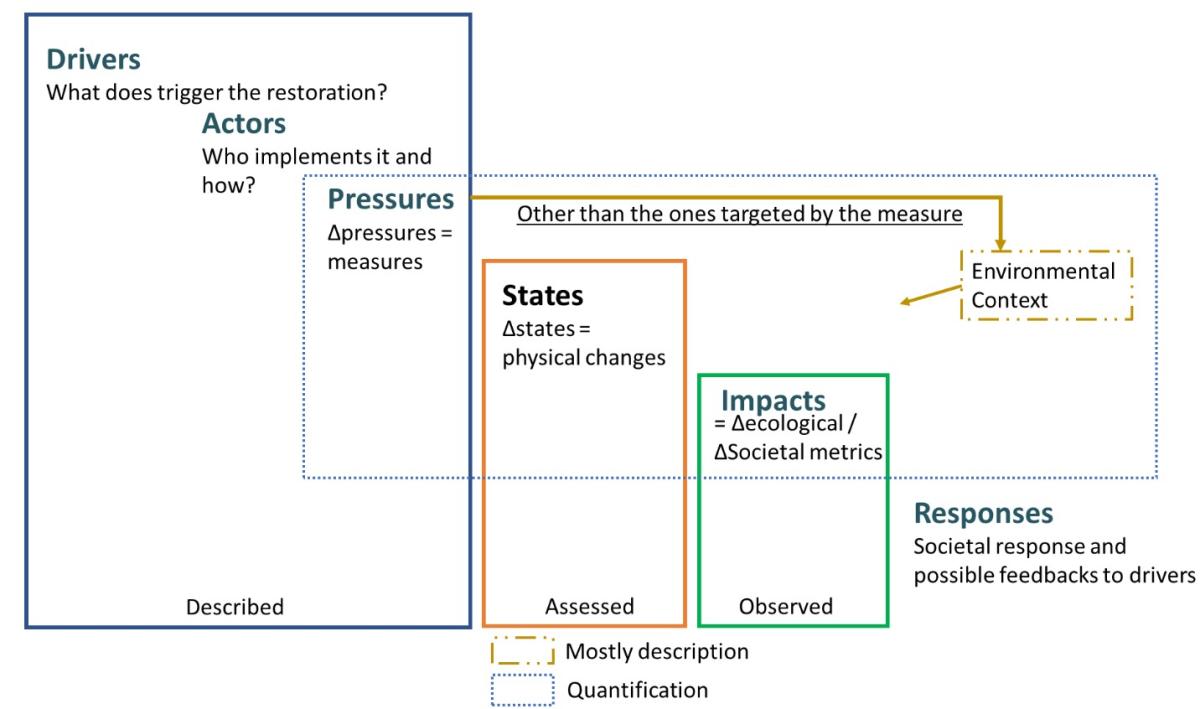
Figure 1. Conceptual cascade of the DAPSIR framework, adapted from the DPSIR framework for the restoration context. It illustrates the causal relationships between the decision-making process of restoration (the Drivers and Actors stages), the Pressure stage (which represents the pressures targeted by the restoration measure), the resulting changes in the physical state of the system, and the resulting impacts on ecological and societal metrics. It also shows the final response of society and provides feedback for the Drivers and Actors stages. The blue dots show the predictive model's focus on the P-S-I part of the framework.
5. Content
Introducing DAPSIR Framework
Here the DPSIR-framework is adapted to better account for the context of river restoration. In the new DAPSIR framework, we introduce an additional layer for actors and their activities involved in implementing restoration projects, which may be subject to local constraints. Additionally, we redefine the Driver layer to refer to drivers for river restoration instead of drivers for pressures (Figure 1).
The proposed DAPSIR framework can be read as follows:
- Drivers (D) for implementing restoration measures and a description of the triggers for action (e.g., the desire to stop biodiversity decline or reverse habitat degradation, as expressed through European, national, or territorial directives; local opportunities; local negotiations; willingness, etc.).
- Actors (A) involved and their activities implementing the local project (e.g., a municipality or water management organization contracting a consulting firm responsible for fieldwork, or an industry engaged in a compensation project).
- Pressures (P) that impair the good status of rivers. In river restoration practices, these pressures are corrected by specific measures (e.g., creating in-stream still-water zones, reconnecting streams to floodplains, and adding boulders or deadwood). Pressures and measures are two sides of the same coin and are considered interchangeably.
- State (S) of the stream's physical structures and processes, which are impaired by pressures and supposedly enhanced by restoration measures (e.g., diversity of facies, stream depth, etc.).
- Impacts (I) of restoration on ecological and societal metrics (e.g., taxonomic richness of fish, abundance of sensitive macroinvertebrate taxa, etc., see associated factsheet ‘Measuring the biological outcomes of restoration’).
- Response of society (R) to these impacts on different spatial scales (local-national). This response can lead to retroaction on drivers and actors, which can enhance or limit the expansion of restoration. For example, citizens may feel an increased sense of well-being following local restoration and create associations to promote new projects.
Although the DAPSIR approach proposes a conceptual framework to consider the entire decision-making and consequence chain in the context of river restoration, specific parts of this framework can be modeled based on current knowledge. Here, we focus on the P-S-I part of the DAPSIR cascade (Figure 2). This corresponds to the in-stream part of the framework, for which the existing scientific knowledge allows us to propose a model that links ecological metrics responses to changes in physical states following a wide range of typical restoration measures and their combinations. We also introduce the possible influence of the environmental context on these causal relationships to improve the prediction of possible outcomes from restoration projects.
Pressure-impact relationships have been studied for a long time. Formerly, scientific practices focused on single pressure effects; however, they have evolved towards studying multiple pressures (or multiple stressors). Literature reviews have provided extensive summaries by aggregating scattered results observed in different contexts. However, a comprehensive model representing the complexity of interactions between physical and biological responses to restoration measures is still lacking. Such a model would allow us to predict restoration outcomes across contexts.
Model aims
This PSI section was designed to be as integrative as possible. It follows three main objectives:
- Comprehensiveness. Through its graphical structure, the model aims to provide a more comprehensive representation of the possible interactions between various variables. Any arrow pointing from variable A to variable B indicates that variable A influences variable B. Similarly, if variable C is influenced by variables A and B, then variable C depends on variables A and B. Thus, the model describes all possible direct and indirect pathways of influence between common restoration measures and a set of complementary ecological metrics of invertebrate and fish communities. The model also introduces the influence of various environmental context variables that control or mitigate the responses of dependent physical or ecological variables (i.e., interactions between restoration outcomes and context).
- Help predict the potential ecological outcomes of a set of applied restoration measures. Applying one or more restoration measures will alter the physical state, including processes and structures, thereby inducing a change in the predicted ecological metrics. The effect will differ depending on the context. The model also inherently describes the uncertainties associated with these predictions.
- Help identify the most promising measure or set of measures to achieve a desired ecological response. Bayesian networks allow us to reverse the inferred relations. By fixing the environmental context and the desired change in the influenced variables, we can determine which changes in influencing factors are most likely to have caused the expected result. This can be useful for designing more efficient restoration plans. Once again, the associated uncertainties are produced when using the model.
Model structure
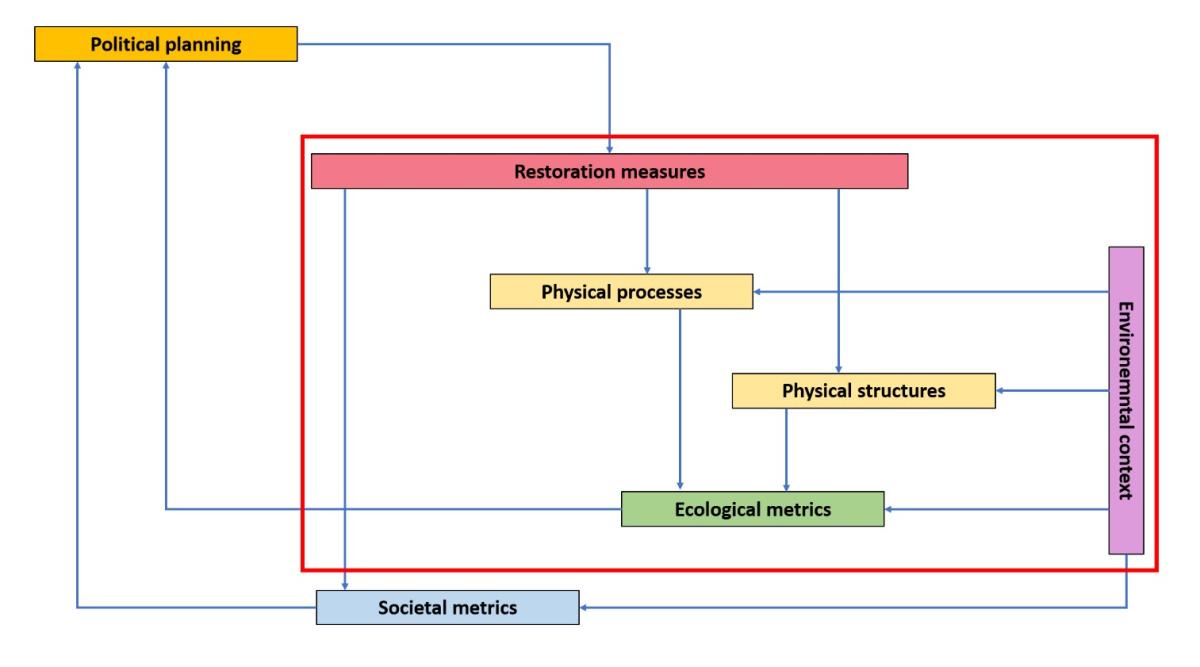
Figure 2. Summary description of DAPSIR, with a focus on the Bayesian Belief Network (red box), which describes and computes the causal cascade from river restoration measures to ecological metric outcomes.
A Bayesian Belief Network was developed that explicitly represents the various interactions existing between the different physical structures and processes in the river and the biological responses to restoration (Box 1). This model is process-based and graphically represents the expected causal relationships between different layers:
- A “restoration measures and practices” layer, introducing the individual most common restoration measures;
- A “physical processes and structures” layer, depicting the possible physical states of the system;
- An “ecological metrics” layer, describing how biological assessment metrics should respond to physical states changes;
- An “environmental context” layer, describing the possible confounding effects leading to stronger or weaker changes in the other layers’ variables.
The model considers changes in physical states before and after restoration. However, the responses of hydromorphological processes and structures can vary over time, and the time lags in response to restoration are poorly documented. Therefore, the model is designed to compare the initial and final states once the latter has reached dynamic equilibrium, which usually occurs between five and ten years after restoration. Similarly, ecological responses are difficult to depict, and the expected outcomes correspond to those after a stabilization phase of 5 to 10 years. A complete list and description of all variables considered in the model can be found here: https://doi.org/10.57745/NC9LCK.
In the graphical model structure, each variable is represented by a box. Causal links between variables are depicted with arrows pointing from the responsible variable to the influenced variable.
Next, quantitative values will be applied to the represented causal relationships based on expert knowledge and expressed as probabilities of occurrence. This will take the model beyond graphical conceptual models based on literature synthesis (e.g., the WISER project) and demonstrate more than just trend relations. It will show the expected outcomes of restoration measures and quantify their likelihood according to the context.
Figure 3 provides an example of the box-and-arrow representation of causal relationships.
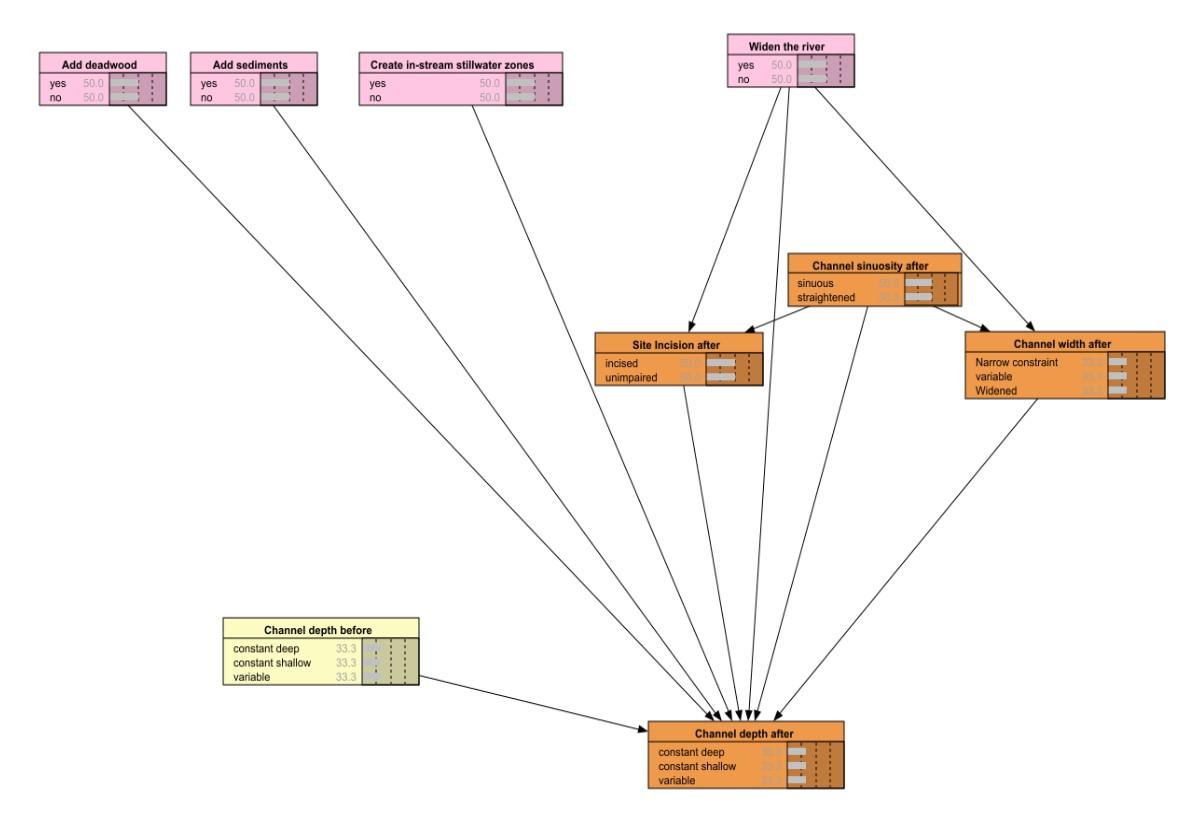
Figure 3. Example of the submodel that explains the "channel depth after restoration" variable through causal relationships. This submodel must be read as follows: the "Channel depth after" restoration state depends on the "Channel depth before" restoration state. It also depends on the "Site incision after" state. Incision causes a deepening of the channel. Therefore, if incision still occurs, the final channel depth is likely to be deeper. The "Channel sinuosity after" state. Morphologically, an increased sinuosity of the channel tends to favor various depth conditions. The "Channel width after" state: Hydromorphologically, the wider the channel, the shallower it is. The "Channel sinuosity after" has a direct causal effect on "channel depth after," as well as indirect causal effects through "site incision after" and "channel width after." However, thanks to the BBN methodology, there is no redundancy in these effects. Four restoration measures can directly correct ‘Channel depth after’: add deadwood, as its presence can act as deflectors and improve depth variability; add sediment to reconnect the stream to its floodplain naturally, which should lead to a shallower channel.; create in-stream stillwater zones. This measure usually involves creating protected deeper zones, thus fostering greater variability in channel depth.; widen the river. If implemented as a standalone measure, it tends to promote shallower waters.
Box 1: Bayesian Belief Networks, model fitting and elicitation process
Bayesian belief networks are widely used in environmental sciences to model environmental complexity and inform decision-making regarding various environmental issues (Oprea, 2018 https://doi.org/10.1016/j.envsoft.2018.09.001). In Bayesian approaches, model parameters are not single values, but rather probability distributions that express the credibility of their possible values. Therefore, risk and uncertainty can be estimated more accurately than in models that consider only mean values (Uusitalo, 2007 https://doi.org/10.1016/j.ecolmodel.2006.11.033). BBNs are an appropriate method for dealing with uncertainty intrinsically (McCann et al., 2006 https://doi.org/10.1139/x06-238; Pollino & Hart, 2008, and risk distributions for each endpoint can reflect uncertainty in the model's results (Liu et al., 2019 https://doi.org/10.1016/j.jenvman.2019.06.060). Technically, BBNs rely on conditional probability relations that can be easily reversed. Knowing the cause allows one to infer the most probable consequence, and knowing the consequence allows one to assess the most probable cause. This allows for two-way assessments of causal models.
Using probability vectors instead of single values allows for a straightforward representation of the most probable decision and the associated uncertainty.
Figure I provides this graphical representation in the form of a histogram. Consider an explanatory variable with three possible levels. The sum of the individual probabilities of this variable taking each of its levels equals 100%. In case a., the probability of the variable taking level 1 is far higher than the probability of it taking any of its other levels. This leads the decider to be confident in the level 1 result. In case b., the decider would likely choose level 2 but would be more concerned that the variable could still take level 1.
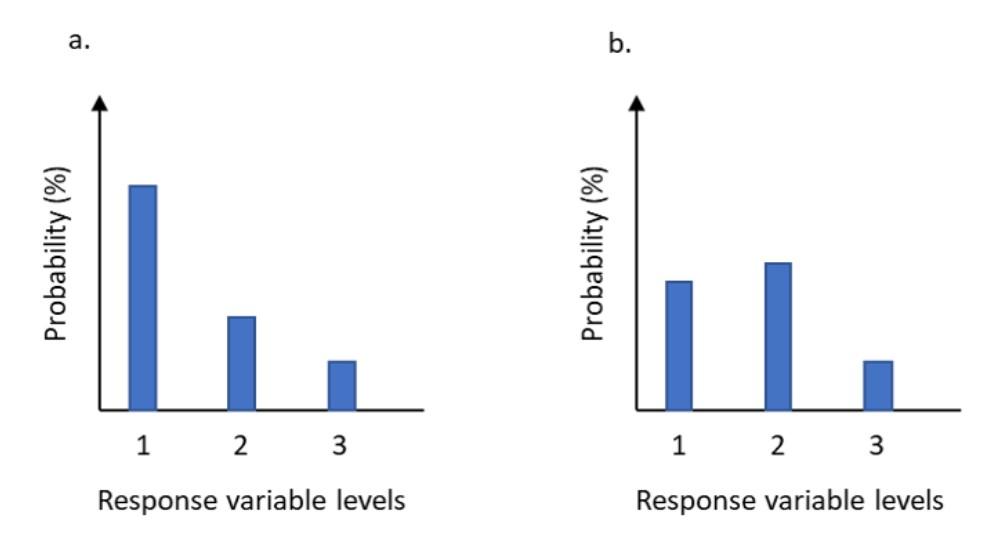
Figure I. Examples of probability vectors, represented in the form of histograms. In both cases (a. and b.), the probabilities sum to 100%.
The model was designed through a collaborative process involving ten researchers, most of whom were ecologists, and one modeler. The process comprised three steps: i) Define the list of variables of interest to include in the model and agree on clear definitions. ii) Define the graphical structure of the BBN, determine the possible states of each variable, and identify the causal links between variables. iii) Elicit the quantitative strength values for each expected link, along with their associated uncertainties. This means determining all the individual conditional probabilities for each considered variable. This last step is still under construction. It is defined as a probability vector that distributes 100% of the probability among the different possible states of the studied variable for all combinations of states of the causal variables (i.e., under the assumption that all the influential variables are in defined states, and all of these state combinations are assessed). Each researcher must express a quantified assumption for each link in the model, and then all values are averaged. This allows for the integration of differences in assumptions between researchers and the quantification of the uncertainty associated with the predicted state of the variable.
6. Costs and benefits
In its final version, this model should require only a short time investment to understand its logic and limitations. In return, it should help optimize efforts to identify the most relevant restoration measures to achieve higher ecological outcomes according to the environmental context. This should help:
• Optimize expenses on restoration measures;
• Communicate expected biodiversity objectives of restoration, and enhance social acceptance.
7. Specific conditions
The PSI Bayesian Belief Network was developed for Western European rivers by the COSAR scientific group and facilitates a more integrative analysis of possible restoration outputs by considering all aspects of restoration. Although the proposed DAPSIR framework can be applied to a wide variety of river types and restoration activities in Western Europe, using this model to predict restoration outcomes for river types outside this geographical area should be approached with caution.
8. Governance
9. Examples of (practical) applications
10. Knowledge gaps
This work emphasizes the importance of considering the entire decision-making process involved in river restoration implementation. The drivers of restoration decisions and how actors implement local plans are important factors in analyzing the outputs of restoration projects. Similarly, positive societal feedback could play a fundamental role in future restoration actions. Further efforts to integrate these two aspects into a general model are necessary.
For now, a conceptual model describing the physical responses of rivers to restoration measures and their consequences on ecological metrics has been developed. Further efforts should integrate longitudinal and lateral continuities as strong drivers of community recovery.
Finally, eliciting conditional probability tables would enable this model to predict the expected outcomes of future restoration actions.
The model is a Bayesian Belief Network that can integrate expert knowledge. This model is still under development. In its final version, it will use conditional probability relations that can be used in two different ways. First, given a restoration measure in a known context, one can infer the most probable ecological changes. Second, given a specific ecological goal in a given context, one can design the most accurate restoration project to achieve that goal.